
CSAT Period 4: Korean History for 30 Minutes, Then Inquiry Subjects 30 Minutes Each -- 2 Minutes to Collect the Booklet, and Opening Another Subject's Booklet Voids Every Exam
On the 2027 CSAT, period 4 runs Korean History for 30 minutes, then inquiry subjects 30 minutes each. Booklet swap, start time for one-subject candidates, storage envelope and invalidating acts.
Period 4 of the CSAT is built differently from the others. Korean, math and English are each taken as one block, but in period 4 the 30-minute Korean History section is followed, within the same period, by the inquiry section, and a candidate who chose two inquiry subjects sits them 30 minutes each, swapping test booklets in between. The 2027 CSAT takes place on Thursday, November 19, 2026. This article lays out the period 4 sequence by clock time, based on the application guidance in the 2027 CSAT Implementation Guidelines from the Korea Institute for Curriculum and Evaluation (KICE).
At 3:20 p.m., when Korean History ends, candidates with no inquiry subject move to a waiting room
For regular candidates, the Korean History section of period 4 starts at 2:50 p.m. and the end bell rings at 3:20 p.m. Every candidate takes Korean History, so everyone sits it in the same exam room. When the bell rings, the proctor collects the Korean History answer sheet and booklet, and candidates who did not choose an inquiry subject move to a waiting room.
Two inquiry subjects: 30 minutes each, with 2 minutes in between to collect the booklet
In rooms for candidates with two inquiry subjects, the first subject begins at 3:35 p.m. According to the period 4 schedule in the guidelines, the first subject ends at 4:05 p.m., the booklet is collected and the second subject's booklet is checked, the second subject begins at 4:07 p.m., and the whole period ends at 4:37 p.m. Each subject is 30 minutes, and the 2 minutes between them are for swapping booklets. Use that time to confirm that the booklet matches the second subject written on the sticker on your desk.
Candidates with one inquiry subject start at 4:07 p.m.
Rooms for candidates with a single inquiry subject run differently. After the 3:30 p.m. preparation signal, the same schedule says candidates must wait quietly, and any marking, self-study or other test preparation is prohibited. At 4:02 p.m. the inquiry booklets and the envelope for storing personal booklets are handed out, around 4:05 p.m. you confirm that the booklet matches your chosen subject, and at 4:07 p.m. you begin writing answers. The period ends at 4:37 p.m., the same as for candidates with two subjects.
Booklets for subjects other than your current one go into the envelope and onto the floor
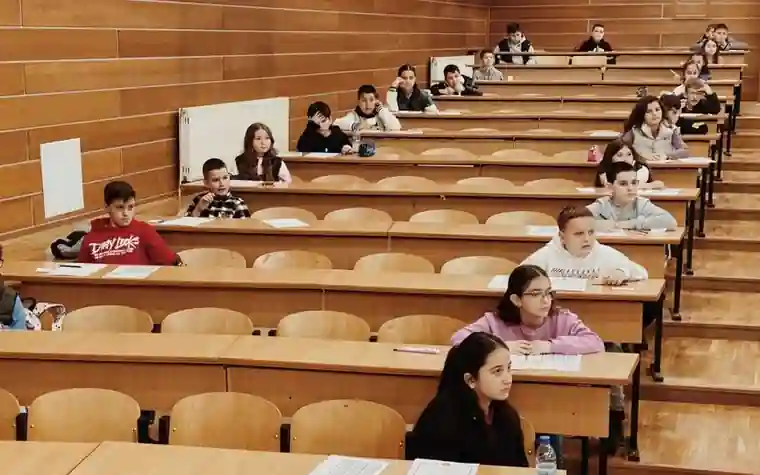
The inquiry section is handed out as one booklet covering all social studies, science and vocational subjects. For each 30-minute block the guidelines require that only the booklet for the subject being tested stays on the desk, and everything else, including the cover, goes into the envelope provided for personal booklets and is placed on the floor. Even if you want a look at your second subject, the only thing allowed on the desk is the subject for the current time.
Three actions count as cheating and invalidate every exam
The guidelines say that in period 4 the following three actions are cheating and invalidate all of the candidate's exams. (1) Looking at the booklet of a subject other than the one currently being tested, or looking at two or more subjects' booklets at once. (2) Writing or changing first-subject answers during the second subject's time. (3) Continuing to write or change answers after the end bell for a subject. For how violations are handled by type, see our article on CSAT cheating types and invalidation standards.
After the end bell, you cannot write on the answer-check sheet either
The end-bell rule in (3) applies equally to the answer-check sheet. The guidelines state that writing answers after the end bell of any period, including filling in the answer-check sheet, is treated as cheating. Because the inquiry section has two end bells within one period, each subject must be finished within its own time. The format and the personal pen conditions are covered in our article on when you may fill in the answer-check sheet. There is no separate clock in the exam room, so for wristwatch conditions see our article on analog watches and prohibited items.
The whole day and the lunch break
For a regular candidate the day runs like this. Be seated by 8:10 a.m. Period 1, Korean, runs 8:40 to 10:00 a.m. (80 minutes); period 2, math, 10:30 a.m. to 12:10 p.m. (100 minutes); lunch is 12:10 to 1:00 p.m. (50 minutes); period 3, English, 1:10 to 2:20 p.m. (70 minutes). Period 4 begins with Korean History at 2:50 p.m. and the inquiry section runs 3:35 to 4:37 p.m., and period 5, second foreign language or classical Chinese, runs 5:05 to 5:45 p.m. (40 minutes). You need to bring your own lunch. KICE's notice to candidates says that lunch and drinking water are not provided.
Summary in order
(1) The Korean History end bell is at 3:20 p.m., and booklets and answer sheets are swapped regardless of how many inquiry subjects you took. (2) With two subjects, you sit 30 minutes each, starting at 3:35 p.m. and 4:07 p.m. (3) With one subject, wait quietly until 4:07 p.m. with no marking or self-study. (4) Put booklets for other subjects in the envelope on the floor. (5) When the end bell rings, stop both your answers and your answer-check sheet immediately.
The basis is the KICE 2027 CSAT Implementation Guidelines (application guidance, exam timetable and period 4 procedure) and the notice to candidates, current as of October 5, 2026. The guidelines say additional prohibited items will be announced in the 2027 CSAT cheating prevention measures due in October 2026, so recheck notices from KICE and your provincial education office shortly before the exam. This article is a general explanation of exam rules and does not replace judgment about any individual candidate's circumstances.
This is an English translation of an article originally written in Korean. 한국어 원문 보기 ›