
Middle School Students Take No More Than 8 Subjects a Semester -- PE, Arts and Electives Are Left Out, and School Sports Clubs Run 34 Hours a Year
A middle school class hour is 45 minutes, the three-year standard is 3,366 hours, and a semester is capped at 8 subjects. The exceptions in the Ministry of Education framework and the floor on PE and arts hours.
When you first see a middle school timetable, you may wonder why there are so few subjects in a semester, or why PE comes up so often. The structure is not up to each school; it comes from the organizing standards in the Ministry of Education notice on the 2022 revised curriculum framework. That notice contains a sentence saying no more than 8 subjects per semester, and it also lists which subjects are left out of that count. Based on the notice text, this article sets out four pillars of the middle school timetable: the length of one class hour, the three-year total hours, the per-semester subject cap, and the school sports club.

One middle school class hour is 45 minutes as a rule
Below the middle school hours table, the framework says one class hour is, as a rule, 45 minutes, but may be organized flexibly in light of climate and season, student development, the nature of the content and school circumstances. The same notice sets 40 minutes as the rule for elementary school, so moving from grade 6 to grade 7 makes each period five minutes longer. Because it says "as a rule," schools may still schedule block or shortened classes. A period length that differs slightly between schools is not unusual.
The standard class hours over three years are 3,366
For grades 7 to 9 the standard hours are Korean 442, social studies (including history)/ethics 510, mathematics 374, science/technology-home economics/informatics 680, PE 272, arts (music/art) 272, English 340 and electives 170, for a subject subtotal of 3,060 hours. Adding 306 hours of creative experiential activities gives 3,366 hours in total. These figures are based on 34 weeks a year, summed over three years, and the notice calls them "minimum class hours." Dividing by 34 weeks over three years gives roughly 30 hours a week for subjects and about 33 hours a week including creative experiential activities. That is a calculation from the table above, so it may differ from an actual school timetable.
Subjects per semester: no more than 8
The organizing standards include a clause that a school should "organize no more than 8 subjects per semester so that student workload is appropriate and meaningful learning can take place." The aim is to keep too many subjects from stacking up in one semester and inflating coursework and exams. The count can vary depending on how subjects are tallied, so the most accurate way to see the number for your child's school is the curriculum organization table that the school provides.

PE, arts and electives are outside the 8-subject cap
The cap has an exception. The clause reads: "However, PE, arts (music/art), elective subjects and subjects organized in school autonomy time may be organized outside the limit on the number of subjects." The framework lists the elective area as Chinese characters, environment, second foreign languages (German, French, Spanish, Chinese, Japanese, Russian, Arabic, Vietnamese), health, and career and vocation, among others. That is why PE and arts keep appearing in timetables, and why subjects set up in school autonomy time do not run into the cap of 8. School autonomy time itself is covered, including how its hours are secured, in our article on school autonomy time for grade 8.
Schools cannot cut PE or arts hours
A school may increase or decrease hours within 20% for each subject group and for creative experiential activities. But the same sentence adds the proviso that "PE and arts (music/art) may not be organized below the standard class hours." The floor of 272 hours for PE and 272 hours for arts cannot be changed by a school. Adding time is not prohibited. If PE or arts look noticeably thin in a timetable, it is worth comparing the three-year total in the organization table with the standard.
School sports clubs run every semester, 34 hours a year per grade
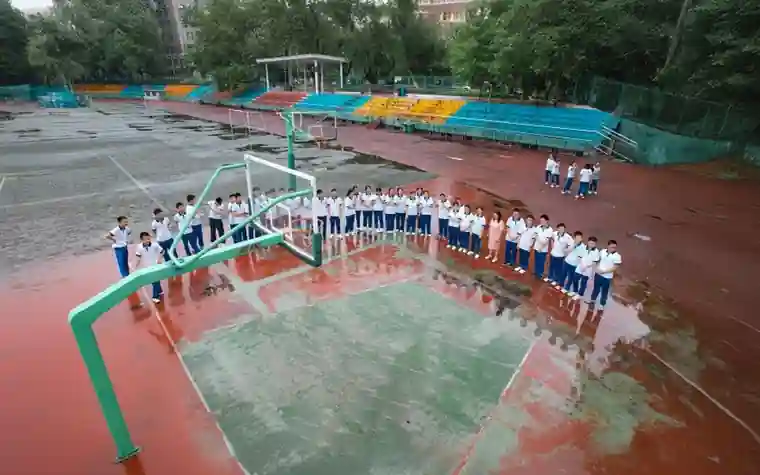
The framework says school sports club activities are organized as club activities within creative experiential activities and run 34 hours a year per grade, to be scheduled in every semester. The summary of changes gives the three-year total as 102 hours. Events and content are decided by the school reflecting student preferences, and a variety of events must be offered to guarantee choice. This is separate from the 272 hours of the PE subject, so club time should not be understood as replacing PE classes.
Informatics is 68 hours or more, and small schools supplement online
Informatics is to be organized for "68 hours or more" using informatics class hours and school autonomy time, among others. Small schools and rural schools that find it hard to open subjects are to expand online use and sharing of local educational resources so that learning gaps do not arise, following guidelines from the metropolitan or provincial superintendent. When a transfer student has not completed a particular subject, the education office and the school must provide supplementary learning so that no gap is left. For how to compare which subjects each school offers, see our article on checking School Info before high school assignment.
What to check on your child's timetable, in order
(1) Open the curriculum organization table that the school publishes in a notice to parents or on School Info and count the subjects in each semester. (2) Check that the three-year total for PE and arts has not been cut below the standard. (3) Look at what name school autonomy time and the electives have been given. (4) One semester of grade 7 runs as a free semester, so for how its grades are counted, check our article on grade 7 grades separately. This article is a general explanation of the framework in Ministry of Education Notice No. 2022-33, and a school's organization may differ following review by its curriculum committee, so please check your child's school's official guidance first.
This is an English translation of an article originally written in Korean. 한국어 원문 보기 ›