
Your Toddler's Checkup Flagged Language for Further Evaluation -- From K-DST Rechecks to Specialist Testing and Voucher Support
The three K-DST result tiers, what a language 'further evaluation' flag means for next steps, and how testing and the developmental rehabilitation voucher connect.
Getting a note that says "Language: further evaluation recommended" at an 18-month checkup leaves most parents unsure what to do first. Here is the actual order of steps, from what the K-DST terms mean to where to get further testing and how it connects to developmental rehabilitation support.
What K-DST is -- the developmental screening built into toddler checkups
The Korean Developmental Screening Test (K-DST) is a parent-completed questionnaire given at every national health checkup from 9 months of age onward. It covers six domains -- gross motor, fine motor, cognitive, language, social, and self-help skills -- with age-specific items, and the checkup physician makes an initial assessment based on the responses. Because it's filled out fresh at every checkup, a domain that was normal last time can come back flagged at the next one.
Three result tiers: on track, monitor, or further evaluation
K-DST results fall into three tiers per domain: on track, monitor, or further evaluation recommended. "Monitor" means observation until the next scheduled checkup, without an immediate referral. "Further evaluation recommended," on the other hand, means the domain is noticeably behind peers, and the checkup provider writes a referral to a facility that can do a full assessment. A language-domain "further evaluation" flag is where the process described here begins.
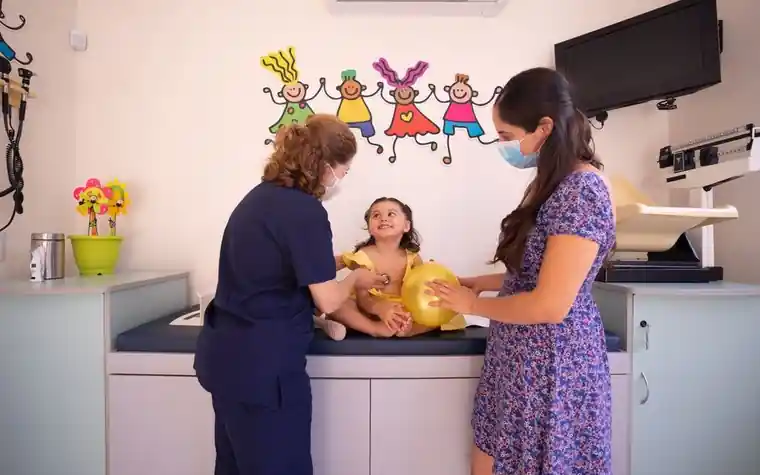
Where and how to get the follow-up evaluation
To get the follow-up evaluation, bring either the checkup results notice issued by the screening provider, or a developmental disability evaluation eligibility certificate issued by your local public health center. With that document, you can be evaluated at a hospital designated by your metropolitan or provincial government, or at a pediatric, rehabilitation medicine, or child psychiatry clinic of your choosing. If language delay is suspected, confirming in advance that the hospital actually offers pediatric language assessment -- and booking early -- helps cut down the wait.
Cost support -- eligibility and application channels vary
If the follow-up evaluation confirms a developmental disability or delay, cost support may be available, but eligibility and procedures vary by local government, so it's worth confirming directly with your public health center. Whether costs are reimbursed after payment or discounted directly at a designated facility also differs by region, so it's worth checking with the health center before booking the evaluation.
If a delay is confirmed -- connecting to developmental rehabilitation services
If the evaluation confirms a language development delay, it often leads to the developmental rehabilitation service voucher. This voucher can be applied for with just a doctor's referral, without registering a disability, and covers children under age 9 with a co-payment that scales with household income from 0 to roughly 80,000 won per session. Actual intervention services like speech therapy or play therapy typically begin through this voucher. Even with the voucher, a per-session co-payment remains, and some families add extra therapy beyond what the voucher covers. For children not yet in school, academy fees can also qualify for the education tax credit up to the pre-school limit (3 million won), so it's worth saving receipts for therapy- and education-related spending for year-end tax filing.

Retesting multiple times still only counts once for cost support
K-DST itself is free and refilled at every checkup, but cost support for the follow-up evaluation after a "further evaluation" flag is generally recognized once per checkup cycle. Shopping around multiple hospitals for repeat evaluations in the same period won't multiply the support, so choosing a facility with real pediatric language-assessment experience from the start saves both time and money.
A common misunderstanding -- "further evaluation recommended" is not a diagnosis
A "further evaluation recommended" flag is only a screening result indicating further testing is needed -- it is not itself a disability or a confirmed diagnosis. Language development varies widely between children, and it's common for a follow-up evaluation to come back within the typical range. That said, delaying testing can also delay intervention, so once a child is flagged, booking an appointment as soon as the results notice arrives is the safer move. Children this age are often also attending daycare, so it's worth checking that a therapy schedule doesn't conflict with daycare drop-off and pickup times before committing to a plan.
Summary
1) Confirm a "further evaluation recommended" flag in the language domain at a toddler checkup 2) Get the results notice from the checkup provider or the evaluation eligibility certificate from your public health center 3) Book an evaluation at a designated facility or a hospital with pediatric language assessment 4) Check cost-support eligibility with your public health center in advance 5) If a delay is confirmed, move into the developmental rehabilitation service voucher process. This article is general procedural information; the developmental evaluation and treatment direction for any individual child should always be decided with a specialist.
This is an English translation of an article originally written in Korean. 한국어 원문 보기 ›